
Overview of the Illinois Permit Test
 The Illinois permit test is a 35-question written exam based on the 2026 Illinois “Rules of the Road” handbook. This exam determines whether you have the knowledge needed to safely operate a vehicle on Illinois roads. To pass, applicants must answer at least 28 out of 35 questions correctly, which equals an 80% passing score.
The test is administered by the Illinois Secretary of State (SOS) at Driver Services facilities located throughout the state. Whether you’re a teen eager to start driving or an adult obtaining your first license, this exam is your gateway to getting behind the wheel.
Here’s what you need to know at a glance:
Format: 35 multiple-choice and true/false questions
Passing score: 28 correct answers (80%)
Administrator: Illinois Secretary of State Driver Services facilities
Content covered: Road signs, Illinois traffic laws, safe driving rules, cell phone restrictions, and school bus laws
Who takes it: Teen permit applicants, adults seeking their first license, and some new Illinois residents
Illinois DMV Permit Practice Test Format and Key Facts
Understanding the format of the Illinois DMV permit test helps reduce anxiety and lets you focus on what matters—demonstrating your knowledge of Illinois rules.
The standard Class D written permit test consists of 35 questions presented on a computer terminal or touchscreen kiosk at the facility.
You must get 28 or more answers correct to pass. Some facilities use adaptive scoring systems that end the exam automatically once you’ve mathematically secured a passing or failing result.
Questions are randomly selected from a larger question bank maintained by the Illinois Secretary of State, meaning no two tests are identical.
The test is available in English, Spanish, Hindi, Vietnamese, and several other languages. Check the SOS website or call your local facility to confirm language availability before your visit.
As of 2026, all content is based on the most current edition of the Illinois “Rules of the Road” handbook, which is updated regularly to reflect changes in state law.
Most applicants complete the exam in 15–30 minutes, though you’ll have adequate time to read each question carefully.
Eligibility: Who Can Take the Illinois Permit Test?
Your age and prior driving history determine when and how you can apply for an Illinois learner’s permit. Here’s how eligibility breaks down for different groups:
Teens age 15: You can apply for an instruction permit (Class D) if you are currently enrolled in an approved driver education course. This course includes 30 hours of classroom instruction and 6 hours of behind-the-wheel training.
Teens age 16–17: If you haven’t obtained your license yet, you must get a learner’s permit and meet all Graduated Driver Licensing (GDL) requirements before taking the road test.
Adults 18 and older: If you’ve never been licensed in any state or country, you must pass the same written test to obtain an Illinois instruction permit or driver’s license.
New Illinois residents: Those with a valid out-of-state license may be exempt from the written test in some cases. However, if your license has expired or you hold a foreign license, you’ll likely need to take the exam.
Drivers requiring re-examination: Some drivers must retake the written test after medical reviews, license suspensions, or serious traffic violations, such as a DUI.
How to Apply for an Illinois Learner’s Permit
Getting your permit requires an in-person visit to an Illinois Secretary of State Driver Services facility. Online applications are not available for first-time permits. Here’s the process in chronological order:
Visit an Illinois Secretary of State Driver Services facility during operating hours. Some locations accept walk-ins while others require appointments—check the SOS website before you go.
Bring proof of identity, date of birth, Social Security number (or acceptable alternative), and two documents proving Illinois residency. The SOS “Acceptable Documents” list on their website details exactly what qualifies.
If you’re 15–17 years old, provide proof of enrollment in or completion of a state-approved driver education course. This documentation typically comes from your high school or a commercial driving school.
Complete a vision screening at the facility. You must meet minimum visual acuity standards (20/40 with or without corrective lenses) and demonstrate peripheral vision of at least 140 degrees.
Applicants under 18 must be accompanied by a parent or legal guardian who will sign the consent and accept financial responsibility for the minor’s driving.
Pay the current permit fee as listed in the latest Rules of the Road handbook or on the SOS fee chart. Note that fees are subject to change due to legislative or policy updates.
Illinois Learner’s Permit Restrictions and GDL Rules
Holding a learner’s permit comes with legal limits designed to keep new drivers safe while they build driving experience. Understanding these restrictions is essential before you get behind the wheel.
Drivers under 18 with an instruction permit must always be supervised by a licensed driver who is at least 21 years old, has at least one year of driving experience, and sits in the front passenger seat.
Nighttime driving restrictions apply: permit holders under 18 generally cannot drive between 10 p.m. and 6 a.m. Sunday through Thursday, and 11 p.m. to 6 a.m. on Friday and Saturday. Verify current curfew times on the SOS website, as these may be updated.
All vehicle occupants must wear seat belts. For teen drivers, the number of passengers may be further limited by GDL rules or local ordinances.
The permit is valid for up to 2 years for most teen applicants. However, you must maintain good standing in any driver education and school attendance programs as required by Illinois law.
Handheld cell phone use and texting are strictly banned for all permit drivers. Any moving violation can delay your progression to a full license and may result in additional penalties.
How Long You Must Hold Your Illinois Permit
The waiting period between getting your permit and taking the road test depends on your age. Illinois uses a Graduated Driver Licensing program to ensure new drivers gain sufficient experience before driving independently.
Teen drivers (under 18): You must hold your instruction permit for a minimum of 9 consecutive months before applying for a driver’s license.
Required practice hours: Teen drivers must complete at least 50 hours of supervised driving, including 10 hours at night, with a qualified supervising driver (at least 21 years old with one year of experience).
Tracking your hours: The Illinois SOS and many driver education programs offer printable or digital driving logs to track practice hours. Keep this log updated—it may be requested when you apply for your license.
Adults 18 and older: There is no legally mandated minimum holding period. However, most new drivers are encouraged to practice for several weeks or months before attempting the road test to build confidence and skill.
What to Study for the Illinois Permit Test
Your primary study resource is the official Illinois “Rules of the Road” handbook, available free on the Secretary of State website and in print at Driver Services facilities. This handbook contains everything you need to pass.
Focus your study time on these priority topics:
Road signs and signals: Know the shape, color, and meaning of every sign type, including warning, regulatory, and guide signs.
Right-of-way rules: Understand who yields in various situations, including at intersections, when merging, and in emergency scenarios.
Speed limits: Memorize limits for residential areas, school zones, highways, and construction zones.
Lane usage and passing: Know when you can change lanes, pass other vehicles, and use turn lanes properly.
Parking rules: Learn the distance requirements for parking near fire hydrants, crosswalks, and railroad crossings.
School bus laws: Illinois has strict rules about stopping for school buses. Missing these questions is common, so study the exact stopping distances and exceptions.
DUI and zero tolerance laws: Understand the legal blood alcohol limits and the severe consequences of driving under the influence.
Cell phone and texting restrictions: Know that handheld device use is prohibited and the penalties for violations.
Illinois-specific laws: Study Scott’s Law (Move Over Law), construction zone penalties, and child passenger safety seat requirements.
Many test questions focus on specific numbers and distances—following distances, how far to signal before turning, and stopping distances from school buses when two cars approach from opposite directions. Memorize these figures.
While third-party apps and the Illinois DMV Permit Practice Test can help reinforce your learning, always cross-check information with the current Rules of the Road. Only the official handbook reflects current Illinois law.
Taking the Illinois Permit Test at the SOS Facility
Knowing what to expect on test day helps you stay calm and focused. Here’s a walkthrough of the typical experience:
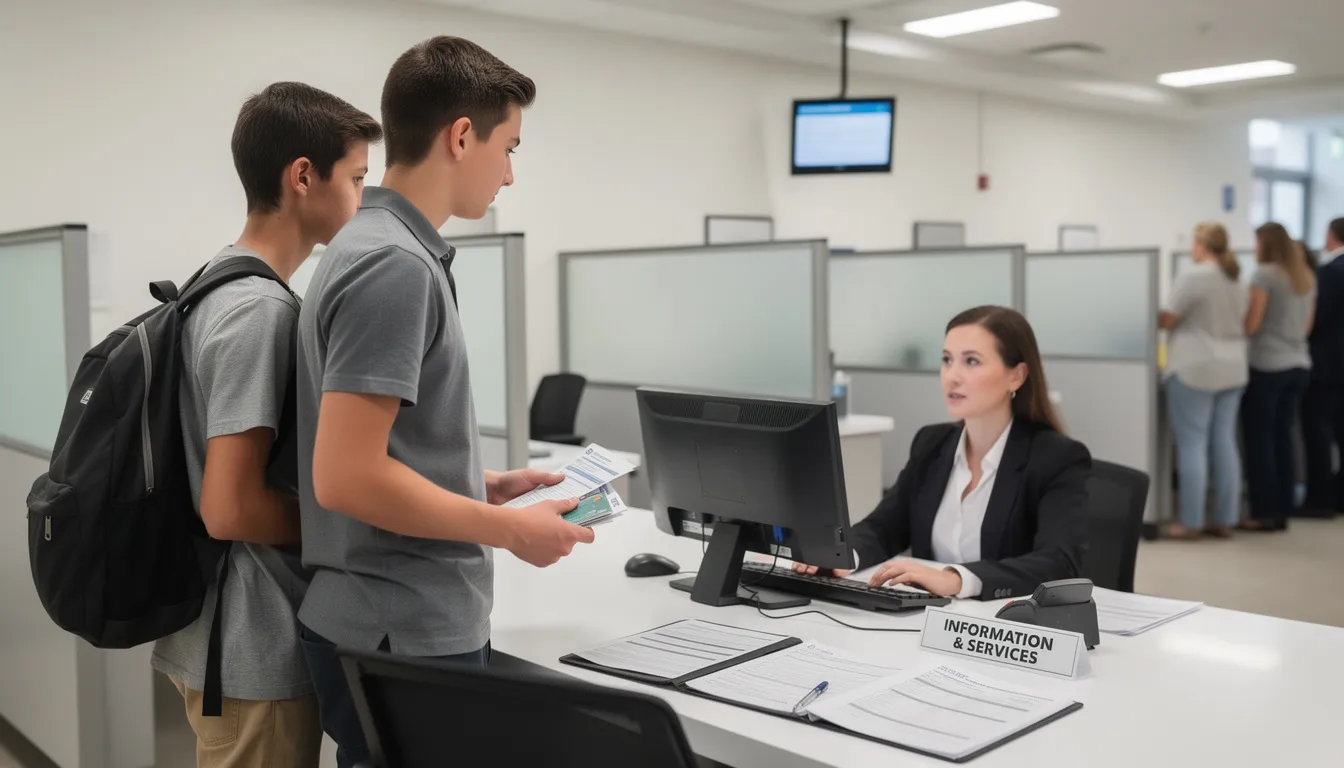
When you arrive at the Driver Services facility, check in at the information desk. Staff will verify your documents, confirm your eligibility, and direct you to the vision screening station. Once you pass the vision exam, you’ll be assigned to a computer testing station.
Most facilities use touchscreen terminals or desktop computers. The interface is straightforward—select your answer and move to the next question.
Questions appear one at a time, typically with three or four answer choices. Read each question carefully before responding.
The test is timed, but the time limit is generous. Most applicants finish in 15–30 minutes without feeling rushed.
If your facility uses adaptive scoring, the exam may end early once it’s mathematically impossible for you to fail (or pass), depending on your running score.
Results are available immediately after completing the test. If you pass, you can proceed to have your permit issued and your photo taken during the same-day visit.
Bring corrective lenses if you need them for driving. Your permit will note if corrective lenses are required based on your vision screening results.
If You Fail the Illinois Permit Test
Failing the permit test happens more often than you might think, and it’s not the end of the road. Many applicants don’t pass on their first attempt, especially if they underestimate the exam’s difficulty.
If you don’t reach 28 correct answers, you’ll fail the test. However, many facilities allow you to retake the exam after a waiting period—sometimes the same day, depending on capacity.
Illinois generally allows up to three attempts per application fee within a set period. Verify the current policy on the SOS website, as rules may change.
When you fail, review the specific topics you missed. Common trouble areas include road signs, right-of-way rules, and Illinois-specific laws that don’t apply in other states.
Repeating the written test without additional preparation usually leads to repeated failure. Before any retake, spend substantial time reviewing the Rules of the Road handbook and taking practice tests until you consistently score above 32 out of 35.
The point of the test is to ensure you have the knowledge to drive safely. Use a failed attempt as a learning opportunity, not a reason to give up.
Illinois Road Test: What Comes After the Permit
After you’ve held your permit for the required period and completed your supervised driving hours, you’re eligible to take the road test. This is a separate examination that evaluates your actual driving skills.
The road test assesses your ability to safely operate a vehicle in real traffic conditions.
Common maneuvers tested include:
Starting and stopping smoothly
Turning left and right
Lane changes
Backing up
Parallel parking and other parking techniques
Obeying stop signs and traffic signals
Examiners evaluate your scanning for hazards, proper use of mirrors and signals, adherence to Illinois speed limits, and understanding of right-of-way rules.
You must provide a properly registered and insured vehicle that passes a brief safety check before the test begins. The examiner will verify that your lights, horn, signals, and brakes all function correctly.
Schedule your road test through the Illinois SOS website or by calling your local facility once you meet all prerequisites.
Resources for the Illinois DMV Permit Practice Test
Preparing for the Illinois permit test requires more than just reading—you need to actively test your knowledge. Here’s how to approach your study plan:
Start with official materials: The Illinois Secretary of State provides the Rules of the Road handbook, sample questions (when available), and informational brochures. These should be your foundation.
Use quality practice tests: Look for practice tests that mirror the 35-question format and require an 80% passing score. Focus on resources featuring Illinois-specific content rather than generic U.S. driving questions.
Seek detailed explanations: The best practice exams explain why each answer is correct. This helps you learn the reasoning and legal basis behind traffic rules, not just memorize answers.
Create a study schedule: Combine reading, note-taking, and multiple rounds of practice questions over several days or weeks. Avoid cramming the night before—spaced repetition leads to better retention.
Track your progress: When you can consistently score 32 or higher on practice tests, you’re likely ready for the real exam. If you’re scoring below 28, continue studying before scheduling your test.
Documents and Preparation Checklist Before You Go
Before heading to the Driver Services facility, use this checklist to ensure you have everything you need:
Required documents for all applicants:
Proof of identity (certified birth certificate, valid passport, or other approved document)
Proof of date of birth (often satisfied by an identity document)
Social Security card or acceptable alternative
Two documents proving Illinois residency (utility bills, bank statements, school transcripts, or other approved items from the SOS acceptable documents list)
Additional requirements for applicants under 18:
Parent or legal guardian present to sign consent and accept financial responsibility
Proof of driver education enrollment or completion certificate
Before your visit:
Verify your local facility’s hours and whether appointments are required on the SOS website
Check if your facility accepts cash, cards, or requires cashless payment
Bring corrective lenses if you need them for the vision screening
Review any medical conditions that could affect your vision test results
Day of the test:
Arrive with enough time to complete paperwork, vision screening, and the written test
Bring payment for the permit fee
FAQs
How many questions are on the Illinois permit test? The test has 35 multiple-choice and true/false questions.
What score do I need to pass? You must answer at least 28 questions correctly, which is 80%.
How long is my permit valid? The learner’s permit is valid for up to 2 years.
Can I drive alone with a permit? No. Permit holders must always be supervised by a licensed driver at least 21 years old with at least one year of driving experience, seated in the front passenger seat.
Can I retake the test if I fail? Yes. Illinois generally allows up to three attempts per application fee. Check with your local facility for specific waiting periods between attempts.
Do I need an appointment to take the permit test? It depends on the facility. Some locations accept walk-ins, while others require appointments. Visit the Illinois Secretary of State website to check your local office’s requirements.
What languages is the test available in? The test is offered in English, Spanish, Hindi, Vietnamese, and other languages. Contact your facility in advance to confirm availability.
Are accommodations available for disabilities? Yes. The Illinois SOS provides accommodations for applicants with disabilities. Contact your local Driver Services facility to arrange appropriate testing accommodations.
Is there a separate test for motorcycles or commercial vehicles? Yes. Motorcycle permits and CDL (Commercial Driver’s License) permits require separate written exams covering material specific to those vehicle types.
Key Takeaways
Getting your Illinois learner’s permit is an exciting step toward independence, but it requires preparation. Here’s what to remember:
Study the official Illinois “Rules of the Road” handbook thoroughly
Focus on road signs, right-of-way rules, and Illinois-specific laws
Use practice tests to build confidence and identify weak areas
Gather all required documents before visiting the facility
Understand that the 80% passing threshold means you can only miss 7 questions
With the right preparation and a solid understanding of Illinois traffic laws, passing the Illinois permit test on your first attempt is absolutely achievable. Download the Rules of the Road handbook today, create a study schedule, and start working toward your license.